1. What experience kept showing me
My years of experience have shown me that brand strategy still depends on a kind of invisible labour: competitor lists assembled by hand, colour swatches pulled from screenshots, tone-of-voice notes scattered across tabs, and positioning maps rebuilt from scratch for every client.
The work is essential. The method is not. Agencies and in-house teams still spend days assembling competitive landscapes that should take minutes — not because strategists lack skill, but because the research layer was never designed for the pace of modern strategy. Deliverables stay inconsistent. Insights go stale inside slide decks. By the time the audit is "done," the market has already moved.
That gap — between what brand people need and what their tools actually do — is what kept repeating.
2. Why Brandstance exists
Therefore I developed Brandstance: an automated brand-audit tool that finds competitors, analyses visual identity, and reports on brand strategy — in minutes, not meetings.
It is built for strategists, designers, and agencies who have better things to do than take screenshots. The point is not to replace judgment. It is to remove the busywork that sits in front of judgment, so the strategist can spend time on positioning, narrative, and decisions that actually move a brand.
The live product is at www.brandstance.studio.
3. What the tool actually does
Brandstance turns a brand name and a URL into a structured, shareable audit. In practice, the flow is simple:
- Enter a brand — name, website, and optional market context for a sharper read.
- Let the system work — live search finds typically 8–12 relevant competitors and captures each brand's identity in parallel.
- Get the report — Brand DNA for each competitor, side-by-side comparison, and strategic analysis covering tone of voice, colour palettes, market gaps, and positioning recommendations.
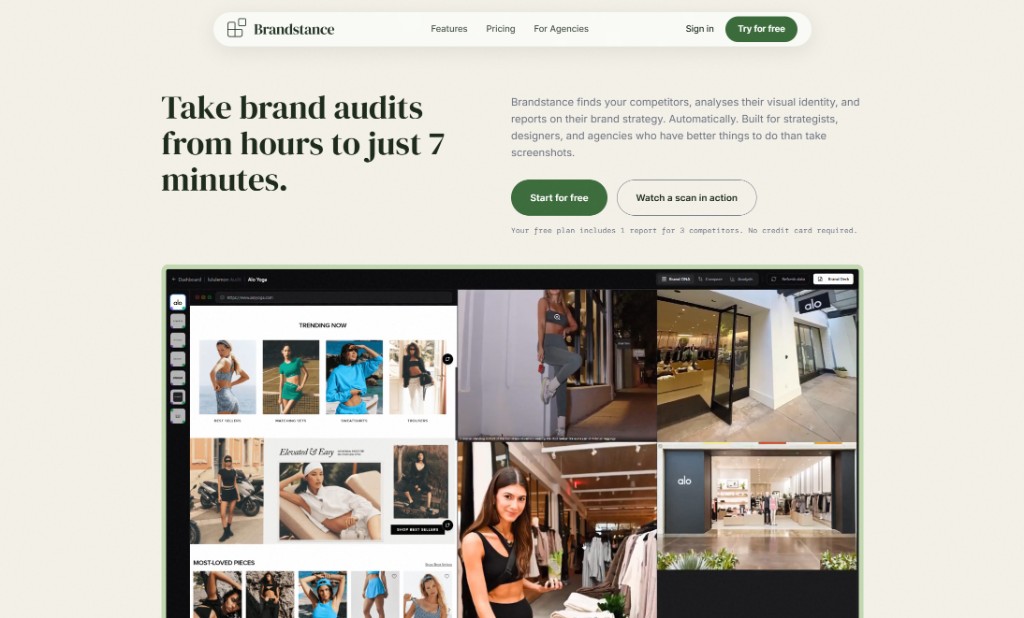
Under the hood, a scan surfaces the signals a real audit needs:
- AI competitor discovery from live search data (not static Wikipedia lists)
- Visual identity capture — colour palettes, typography, logos, and imagery from live sites
- Tone-of-voice profiling across spectra such as formal–casual, serious–playful, minimal–bold
- Brand archetype mapping to see which Jungian positions are crowded and which are open
- Strategic analysis that points to whitespace and next moves
- Export-ready reports — PDF and client-facing brand decks on higher plans
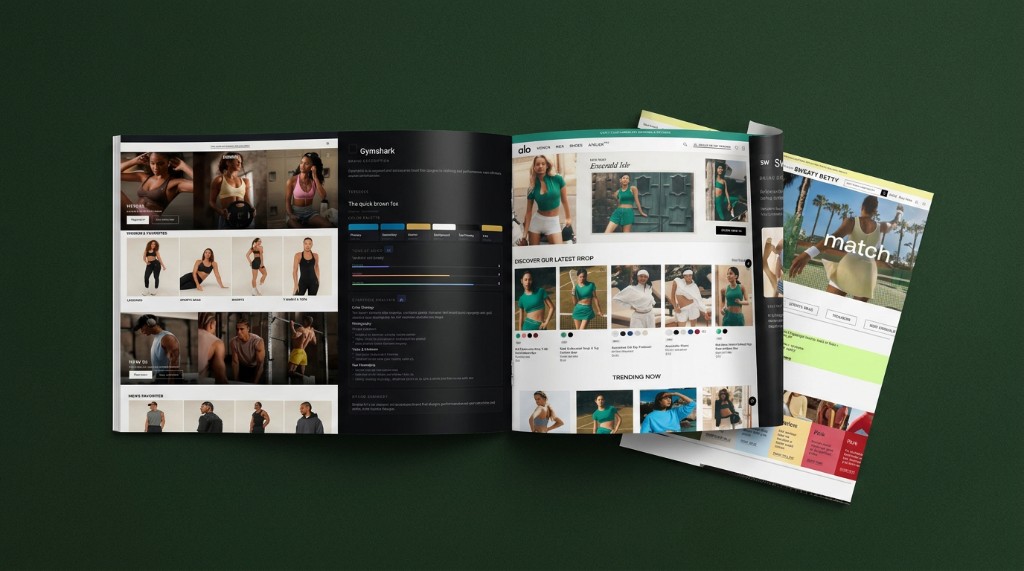
A full audit typically lands in about seven minutes: roughly five minutes of capture, then a couple of minutes of strategic analysis. What used to take days of tab-hopping becomes a single, consistent deliverable.
It is deliberately not an SEO suite, not a social-listening platform, and not sales intelligence. Tools like Semrush, Brandwatch, or Crayon solve different jobs. Brandstance tracks brand identity for people who work on brand strategy.
4. Why it is useful
Brandstance is useful because it compresses the research layer without flattening the craft:
- Time — days of manual competitive research become under ten minutes, freeing capacity for higher-value strategy.
- Consistency — every audit follows the same structured framework, so quality can scale across clients and teams.
- Freshness — scans pull from live web presence, so the landscape reflects what brands look and sound like now, not last quarter.
- Client readiness — reports are formatted to present, not to rebuild in PowerPoint from a folder of screenshots.
- Focus — strategists walk into meetings with evidence already assembled, and spend the meeting on interpretation.
This is by no means the full solution. A serious brand audit still depends on expert strategists, designers, auditors, and experience designers — people who do real in-store visits, in-depth social media analysis, interviews, and the qualitative work no scan can replace. Brandstance does not pretend to own that layer.
The point is the opposite: by taking away the repetitive assembly work — the screenshot folders, the competitor lists, the first-pass visual and tone capture — it gives those experts more time to do the work that actually requires them. Less busywork. More depth where depth matters.
5. What building it taught me
Building Brandstance taught me something more personal than product features. My years of experience showed me a clear problem; today's technology made it possible to go from that problem to a live SaaS solution myself — without reliance on other disciplines like development to translate the vision into something real.
For a long time, creative and strategic people had the insight but not the path. You saw the gap, sketched the workflow, then waited on handoffs: someone else to build it, someone else to ship it, someone else to keep it alive. The vision stayed trapped in decks and briefs while the product lived in another team's backlog.
What changed is the stack. With modern tools, a practitioner who understands the problem can carry the full arc — from framing the need, to shaping the product, to putting a working service in the world. That does not mean taste, strategy, or collaboration stop mattering. It means the dependency on "someone else must build this before the idea can exist" is no longer absolute.
That is the lesson I care about most: when the problem is clear, today's technology is there to solve end-to-end problems and vision without reliance — so the person closest to the work can move from insight to a live product, and keep the human judgment where it belongs.
Try the tool
If you want to see the outcome of that path in practice, try Brandstance at www.brandstance.studio — automated brand audits in minutes, built for strategists and agencies.